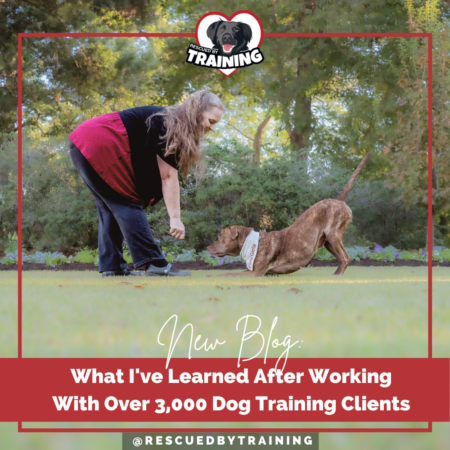

Three thousand clients.
I’ve been eyeing that 3000 number for a while and when I updated my master client log earlier last month I sat trying to figure out how to write about it and commemorate it without it sounding like a humble brag. It’s something I’m very proud of and it feels like a huge milestone for some reason. Then my good friend (and former client who was so good that I convinced her to become a trainer and go to my alma mater The Academy for Dog Trainers, herself) Tayef, suggested I write about what I’ve learned in all that time and I thought it was a brilliant idea! The truth is 3,000 clients have actually taught me that all this is messy and very nuanced and sometimes pretty uncomfortable, and I think that’s exactly what makes it worth writing about!
I started Rescued By Training because of Boo. If you’ve followed me for any length of time, you already know that. She was my heart dog, my reason for doing this work, and her legacy is woven into everything I do. I’ve worked with clients in nearly every situation I can imagine: fearful dogs, reactive dogs, dogs with bite histories, dogs that came from some of the worst circumstances imaginable, and dogs that came from some of the best. I’ve worked with grieving families, overwhelmed first-time dog owners, and people who were absolutely convinced their dog was trying to ruin their life (or kill them in their sleep – legit client fear!)
3,000+ Clients. 11+ Years. 351 Continuing Education Credits.
Before I get into what I’ve learned, I want to say something directly: hiring a qualified behavior consultant is worth it.
Professional licensure is not required to call yourself a dog trainer in the United States. Anyone can call themselves a trainer and charge for it, regardless of education, methodology, or results. There is no licensing board, no required credentials, no consumer protection if your dog ends up worse. You need more licensing to cut someone’s hair than to train their dog.
That matters because when you’re dealing with fear, aggression, reactivity, or separation anxiety because the stakes are real. These are not basic obedience problems – they are complex behavioral and emotional issues that require someone who actually knows what they’re doing. I am multi-credentialed, one of only a small number of credentialed behavior consultants in the country holding multiple behavior consultant credentials (PCBC-A & CBCC-KA) as well as being a certified separation anxiety trainer (CSAT). All those letters can be confusing. I know. I have a post about all that here. I’m also an honors graduate of The Academy for Dog Trainers, the “Harvard of dog training schools” and have spent over 11 years, over 3,000 clients, and have completed 351 continuing education credits staying at the forefront of the science of animal learning. I have over 110 five-star Google reviews from real clients who came to me with real problems and got real results.
Many of my clients come to me after working with several other trainers first. By that point, they’ve spent money, lost time, and sometimes made things harder for their dog. I’m not telling you that to be harsh but because the cost of hiring an under-qualified trainer is almost always higher than the cost of hiring a qualified one from the start.
If you’re deciding whether working with me makes sense, I’d ask you to consider what it’s costing you to keep doing what you’re doing. You’re not failing but need the right help. And I’d love to be that for you.
Now, here’s some of what I’ve learned in all that time.
Not All Dogs Start From the Same Place
This might seem obvious, but it’s something I think a lot of people underestimate when they adopt or purchase a dog. The dog in front of you arrived with a full history, whether you know that history or not. This is part of why I’m so passionate about transparency in rescue and sheltering.
I’ve worked with Sato dogs from Dead Dog Beach in Puerto Rico, feral-adjacent street dogs with no frame of reference for domestic life, who had to learn everything from scratch, including that humans were safe. I’ve worked with Soi dogs imported from overseas who carried that same profound distrust of people and novel environments. I’ve worked with strays pulled from overcrowded shelters in the rural South, dogs who’d been passed through multiple fosters, dogs surrendered after the death or illness of their person and dogs pulled from meat markets with no socialization history at all.
Conversely I’ve worked with dogs from excellent breeders, dogs who had every advantage from the start, who were handled well in utero, raised in enriched environments, introduced to the world thoughtfully. Those dogs still struggle. Good breeding and good early care set a foundation, but they’re not a guarantee.
I’ll say it plainly: the socialization window is real, it closes, and you cannot fully replicate it later. The period between roughly 3 and 14-16 weeks is when puppies form their understanding of what is normal and safe in the world. Experiences during this window have a disproportionate impact on who that dog becomes. Miss it or squander it, and you are working uphill for the rest of that dog’s life.
Then there were all the COVID dogs. A huge wave of puppies adopted during lockdown who missed the most critical developmental windows because the world was closed. No puppy classes, no pet-friendly stores, no exposure to crowds or traffic or strangers. I’m still seeing the fallout from that in my caseload today. Those dogs aren’t broken but they missed things that are very hard to compensate for later.
The point is: where a dog starts matters enormously. It doesn’t mean we can’t help the dog long-term but it definitely shapes their future.
I know there are people reading this who adopted an adult dog or took in a rescue with an unknown history, and I’m not writing this to make you feel bad. We always work with the dog you have. But if you have a puppy right now, please take the socialization window seriously. Not just exposing them to things, but doing it in a way that creates positive associations. Quality matters more than quantity. A single terrifying experience can undo a lot of good work. Get a qualified trainer involved early. It is the single best investment you can make.
The Best Training Plans Are the Ones People Can Actually Follow
I have a graduate-level understanding of animal behavior. I can design an elegant, technically perfect behavior modification protocol but it means absolutely nothing if the person on the other end of the leash can’t implement it in their real life.
Early in my career, I used to hand people a folder of detailed plans. But over the years I’ve learned to gather important information like: What does the client’s day actually look like? What are they willing to do consistently? What’s non-negotiable for that family? What have they already tried?
I tell people something is better than nothing. A training plan that works 50% of the time because someone actually does it will outperform my perfect plan that lives in a folder on the kitchen counter. My job is to meet clients where they are, not where I think they should be. Dog training isn’t and shouldn’t be your full-time job.
This is also why I’m a strong advocate for remote training. Not because it’s easier for me, but because it lets me see the dog in their actual environment, with their actual family, in the context where the problem is actually happening without a stranger/trainer influencing things by being “in the room where it happens” distracting or scaring the dog. That information is invaluable. And, it teaches you, the guardian, how to successfully live with, manage and train the dog. Even if a trainer shows up in person every day, you still need to live with that dog for the other 23 hours in the day.
Medication Is Not “Giving Up” and It’s Not a Magic Fix
Dogs with significant anxiety, fear, or reactivity are suffering. If a dog is stuck in a constant state threat response (fight or flight) or trigger stacking, they won’t be able to learn. Behavior modification without addressing the underlying emotional state is like trying to teach someone to swim while they’re drowning.
Medication, prescribed and monitored by a veterinarian or veterinary behaviorist, can lower the emotional baseline enough that the dog can actually learn. It shouldn’t change who the dog is and shouldn’t sedate them or make them a “zombie.” The right medication, at the right dose creates the conditions for real progress.
I’ve seen medication change lives. I’ve also seen people flat out refuse it out, whether out of pride, or the mistaken belief that it’s a shortcut or a failure, and I’ve watched their dog struggle for longer than necessary. Medication is not giving up – it is helping and advocating for your dog.
If your vet isn’t comfortable with behavioral medications, ask for a referral to a veterinary behaviorist. We have these specialists for a reason and I work closely with many of them, all over the country. I am happy to work with you and give you a referral to one that I trust and have a collaborative relationship with. Just like with any profession, some are better or easier to work with than others.
Rescue Isn’t Always a Fairytale Ending. But It’s Still Worth It.
As you also probably know, we are an active foster family. We’ve fostered over 75 dogs at this point. I love rescue deeply but I will not sugarcoat the fact that rescue can be really, really hard. And, finding a good one is actually really difficult. I can count on my two hands the number of rescues and humane societies in the whole country that I think do it right.
The dog who came from a meat market in another country and is so shut down they won’t eat for days and is too scared to go outside for months. The rescue who labeled the dog as “shy” but who turned out to have a significant bite history. Or maybe the dog who seems “fine” in the shelter but falls apart completely in a home environment. These are real things that happen, and the people who take these dogs on deserve honest support, not toxic positivity about how love will fix everything. Again, choosing a shelter or rescue that is transparent and ethical is so important.
Love is necessary but alone it is not sufficient. What these dogs often need is structure, patience, professional guidance, and yes, sometimes medication. They also need humans who understand that progress is not linear and that setbacks are not failures. And they need training advice that is coming from a qualified source, not AI, not Reddit, not your friends or family and not a Facebook group.
What I can tell you, after 3,000 clients and 75+ fosters, is that the work is worth it, not because every story has a happy ending, (some do end in behavioral euthanasia) but because every dog deserves someone who will try. And the people who show up for hard dogs, consistently, without giving up, are some of the most remarkable humans I’ve ever had the privilege of working with.
Sometimes the Hardest Part of the Job Is the Humans
I want to be honest here, because I think it’s important.
Most of my clients are AMAZING but not every client relationship has been easy. I’ve worked with people who argued with me about basic behavioral science. People who insisted their dog was “dominant” and needed to be put in his place. People who went home and used the shock collar I’d asked them not to use and then wondered why the dog got worse. Or some people who were in denial about the severity of what they were dealing with and needed a hard reality check.
I’ve also had to hold firm on boundaries (autoreply on the weekends, setting my own boundaries to avoid burnout) and I’ve had to have really difficult conversations. On rare occasions, I’ve even had to end working relationships on occasion because the approach being used at home was putting the dog at increased risk or was a public safety risk and I needed to make it officially known I had communicated those risks so it was documented to their vet, in the event there was a tragic incident.
I understand that people come to me at some of the most stressful moments in their lives and that a dog with significant behavior issues affects every part of a family’s daily functioning. And I’m here to support the whole family, even when the family is in disagreement about what should happen. I’m by no means a marriage counselor but I can say, if not everyone is on the same page about what should happen with the dog, the dog will not succeed. The pressure is real but I have a responsibility to protect the dog, the family (especially when there are kids) and the public, and I won’t compromise that.
The clients who made the most progress were almost never the ones with the “easiest” dogs. They were the ones with difficult dogs who who stayed committed to management, not pushing the dog too fast, trusted the process, communicated openly, and kept showing up even when it was hard.
Have a Plan Before You Need One
This one comes from a place that is both professional and personal.
I became a companion animal death doula and pet loss grief companion because of Boo and Barbo. Navigating Barbo’s illness and eventual death made me realize I was not going to be prepared to lose Boo. When I did, navigating her loss while trying to support clients going through the same thing showed me how under-resourced most people are when it comes to anticipating and processing the loss of a dog.
What I’ve seen over and over is that most families have no plan. And it makes sense because we don’t want to talk about loss and death and the scary stuff, both for us and our animals. What are we willing to do for our animals if they get sick? But also, what happens if we get sick? What happens if we’re hospitalized and can’t take care of our animal? Very few people have made arrangements for who would care for their dog in an emergency and they haven’t thought about what they would do if they were diagnosed with something serious, or if their dog outlives them.
If you are facing anticipatory grief, the illness or aging of a beloved dog, or need support navigating loss, my doula and grief companion services are available. This work is an extension of everything else I do, because the relationship between a person and their dog deserves care at every stage.
What 3,000 Clients Have Actually Taught Me
After all of it, here’s what I keep coming back to:
Dogs are remarkably resilient, given the right support. They don’t need perfect but the do need safety, consistency, and someone to advocate for them.
To the clients who do the work, who take in the hard dogs, who show up for the scared and reactive dogs but who manage to follow through even when progress is slow, I just want to say thank you. You’re the reason I do this work.
If you’re in the middle of a hard chapter with your dog right now, I want you to know that hard doesn’t mean hopeless. Let’s figure out what your dog actually needs, and what you actually need, to move forward together.
If you want support putting this into practice, I would love to help. You can book a session here!
And if you are not already on my weekly newsletter list, come join me. Free tips, client wins, and real talk about living with and training hard dogs.
If you would like to support my efforts and make a contribution to allow me to continue to create free resources like my blog and all of my other free resources, you can Buy Me A Coffee!


 (This post contains affiliate links. If you click the link, I earn a small commission, at no extra cost to you.)