
We have a tendency to give puppies a pass. They’re young, cute, still learning and “just being a puppy.” And yes, some puppy behavior is completely normal and does settle with age, consistent training, and appropriate socialization.
But some of it doesn’t.
To be clear, I’m not talking about puppy mouthing and potty accidents. I’m talking about much more serious stuff.
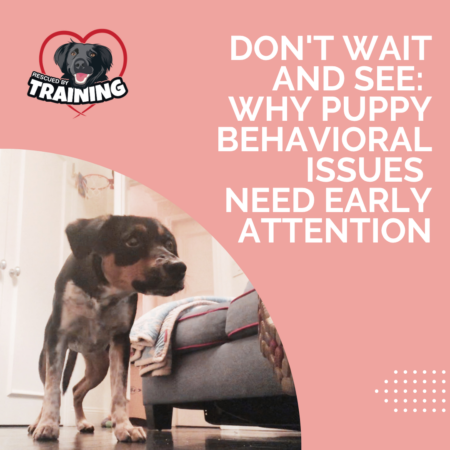
When a puppy is showing signs of resource guarding, early separation distress, or reactivity or aggression toward other dogs, waiting to see what happens could be one of the riskiest things you can do. Not because the behavior is hopeless, but because early intervention is one of your biggest advantages, and every week you wait, you lose a little more of that advantage.
Imagine you’re a human parent, and your two-year-old is showing behaviors that genuinely concern you. Maybe they’re having extreme, inconsolable distress every time you leave the room. Or maybe they’re lashing out physically whenever another child comes near their toys or they’re becoming aggressive toward family members during mealtimes.
Would you shrug and say, “Let’s see how this looks when they’re a teenager”?
I’m going to guess probably not. You’d seek support. You might bring it up with your pediatrician or get some sort of professional evaluation. You’re not going to just let things fester and get worse.
I extend that same logic to puppies in my practice, and it matters just as much.
Puppies are not small adult dogs. Their brains are still developing, and that’s actually good news, because young brains are more plastic, meaning more capable of forming new associations and learning new patterns. The neural pathways aren’t set yet. This is neuroplasticity.
But here’s the part people miss: neuroplasticity works in both directions. A young brain can learn that strangers are safe and sharing is fine just as readily as it can learn that strangers are dangerous and resources must be defended. Whichever pattern gets rehearsed most becomes the default.
Every time a dog practices a behavior, that behavior gets stronger. The neural pathway gets reinforced. What starts as a low-level growl over a food bowl at 12 weeks can become a full bite by 18 months, not because the dog is bad, but because we didn’t teach that young puppy anything different and didn’t condition him to like when people approach him when he has his food.
This is why I say to clients behavior doesn’t usually self-resolve. Ignoring it doesn’t make it go away. It either improves because we actively train it or it gets worse because rehearsal makes it stronger. And early intervention is key. This research shows if behavior isn’t addressed by 9 months of age, there’s a spike in owner-perceived behavioral issues by 12 months. I did a webinar recently and VB Dr. Radosta framed it this way:
Practice makes permanent.
A Recent Client Case Study: Acting Quickly
I’m currently working with a seven-month-old puppy who came to me presenting with resource guarding around high-value objects, her favorite person, and her resting spaces. Her family has three kids 10 and under in the home, which made this a genuine safety concern, not just an inconvenience.
What I want to highlight here is what this family did right: they acted quickly. They didn’t minimize what they were seeing. They didn’t make excuses. They didn’t wait to find out if she’d “grow out of it.” They recognized that these behaviors mattered, took them seriously and sought out professional support.
That decision puts them in a much stronger position. We have a puppy with a still-developing brain, who hasn’t rehearsed these behaviors for more than a month or two, a family that’s engaged and motivated, and a behavior modification plan that has a real chance of creating lasting change. Early intervention isn’t a guarantee, but it dramatically improves the odds.
In this puppy’s case, there’s an additional layer worth discussing. She experienced early trauma: she was removed from her mother because her mother attacked and injured her. That means she missed a critical window for natural socialization with her mom and littermates, including the process through which puppies learn bite inhibition and appropriate social communication.
Early experiences like this shape how a dog’s nervous system develops. Fear, trauma, and disrupted early socialization can all contribute to behavioral presentations later on. This is covered in more depth in my Fear in Dogs series and in my free download, How Fear Is Acquired In Dogs, but the short version is that fearful or painful experiences, especially early in life, can have a really formative impact into adulthood.
This doesn’t mean a dog with a rough start is destined for ongoing problems but it does mean we need to take those early experiences seriously, work thoughtfully, and not assume the dog will simply adjust over time without support.
What “Serious” Behavioral Concerns Actually Looks Like
You don’t need to wait for a bite to happen before you take something seriously. Here are signs that warrant a professional consultation sooner rather than later:
- Growling, stiffening, freezing or snapping when approached near food, toys, or resting spots
- Persistent and intense distress when left alone, even briefly
- Hiding or refusal to interact, take high value food, eat or play in front of people, after an initial decompression period of several days (don’t buy the 3-3-3 rule…don’t wait if your dog is displaying fear issues!)
- Consistent, escalating reactions toward other dogs that don’t respond to basic redirection
- Targeting specific household members with guarding or threat behavior
- Any behavior that feels unsafe, especially in a home with children
These aren’t character flaws and don’t mean your dog is a bad dog. Aggression, in any form is just communication. And the earlier you listen, the more options we have to help your dog.
The bottom line is this. Puppyhood is short. The critical socialization window is even short. The neurological window where learning is most flexible doesn’t stay open forever. If something feels off, trust that instinct and get an evaluation from a qualified, credentialed behavior professional.
Waiting rarely makes behavioral concerns smaller. Early action almost always makes them more manageable.
If you’re seeing something that worries you, reach out. That’s exactly what I’m here for. You can book a session here!
And if you are not already on my weekly newsletter list, come join me. Free tips, client wins, and real talk about living with and training hard dogs.
If you would like to support my efforts and make a contribution to allow me to continue to create free resources like my blog and all of my other free resources, you can Buy Me A Coffee!


(This post contains affiliate links. If you click the link, I earn a small commission, at no extra cost to you.)