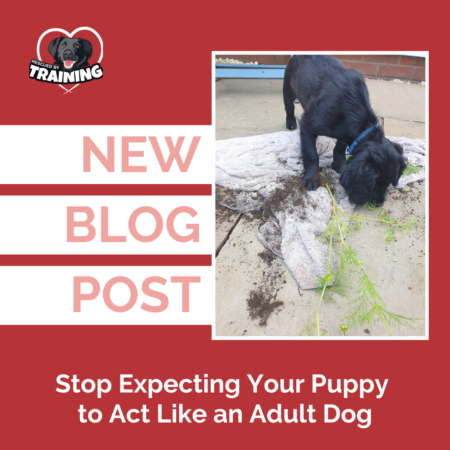

If you have ever found yourself frustrated because your eight-week-old puppy will not stop biting at your hands, had an accident on the rug for the third time this week, or completely ignored you the moment another dog trotted by, you are not alone, and you are not doing anything wrong. Your puppy isn’t broken…they’re just being a puppy and are doing exactly what a puppy should be doing!
We put incredible unreasonable expectations on dogs, but especially on puppies. I am not sure how but somewhere along the way, people started expecting puppies to act the way a calm, well mannered, trained adult dog does. We expect them to walk politely on leash, greet people without jumping, not get excited when they see other dogs, come when called every single time, be able to be left for long periods of time and settle quietly while we work or relax without getting into things. Then when they do none of those things, people get frustrated, annoyed, embarrassed or it feels like a training failure. Or worse, some people think that something is wrong with the puppy.
But let’s stop and think about how strange this would sound if we applied all this to a human child. Nobody hands a toddler silverware and expects them to have perfect table manners at a formal dinner party or sit quietly through a three hour business meeting, wait patiently in a long line, or not have a meltdown when they’re can’t have what they want. We understand and make accommodations for human babies and toddlers without having to think twice about it. We somehow recognize that toddlers are toddlers and give them grace that their brains and bodies are still developing, their impulse control is pretty much nonexistent, and their job at that stage of life is to explore, test limits, and learn. We don’t punish a toddler for being a toddler, (or we shouldn’t!). We set them up for success and safety by managing their environment, guiding them and give them age appropriate experiences and expectations until they mature and can take on more.
But this same logic doesn’t apply when people have puppies. Why not?? Don’t they deserve that same grace? A puppy’s brain is not fully developed until well into their first or second year of life, depending on the breed and size of the dog. During puppyhood, they are working with limited impulse control and a short attention span. Jumping, mouthing, getting overly excited around people and other dogs, having potty accidents, chewing on things they shouldn’t occasionally destroying something you loved, not coming when called, and not staying when asked are not signs of a badly behaved puppy. In fact, they’re signs of a normal puppy.
And, “cue changing” or repeating over and over to “be calm,” “settle,” “be nice,” “be gentle,” “off” or “sit, sit, sit” doesn’t mean anything to a dog, unless you’ve trained those words to be a cue for a specific behavior. Dogs don’t know our language and you repeating it over and over (and over and over and over and over and over and over and over and over) doesn’t make it stick.
Speaking of “sit, sit, sit,” why are we so fixated on sitting? A reliable sit is a nice skill to have, but it is far from the most important thing you can teach your puppy, and treating it as the barometer for good behavior sets both of you up for unnecessary frustration. I wrote more about why we need to rethink our obsession with sitting in my post Quit the Sit. I hope you’ll read it – it might change how you think about what training priorities actually matter during this stage of your puppy’s life, like my Core Four.
Before you start angry posting at me, none of this means you throw your hands up and let your puppy do whatever they want. But it does mean shifting your expectations to match where your puppy actually is developmentally, and putting your energy into the two things that matter most during this window, socialization and enrichment. Contrary to outdated advice, you do not need to wait (and shouldn’t wait!) until your puppy has completed their full vaccine series before you start exposing them to the world. The critical socialization window closes far earlier than most vaccine schedules finish, which means waiting could cost your puppy the chance to build confidence and comfort with new people, animals, sounds, and environments during the exact period when their brain is most open to it. I broke down how to do this safely and thoughtfully in this post, and I strongly encourage every puppy owner to enroll in a well run puppy class. A good puppy class gives your puppy safe, structured exposure to other dogs and people while giving you real support and guidance during a stage that can otherwise feel overwhelming. And, it’s recommended in the AVSAB position statement on puppy socialization. Puppies as young as 7 WEEKS OLD can begin socialization training, even in group classes, as long as they’ve had one round of vaccines and have been dewormed.
Enrichment matters just as much and is not optional. A puppy who is bored is a puppy who will find their own entertainment, and it is rarely the kind you want. Chew toys, food puzzles, sniffing opportunities, age-appropriate play and other appropriate outlets for all that mouthy, exploratory energy give your puppy healthy ways to get all that normal puppy stuff out of their system. The goal is not to eliminate normal puppy behavior but to give them a legal, appropriate outlets for those behaviors, including social enrichment and play and socialization opportunities with their own species. And yes, this means even if you have a housemate dog at home, your puppy still needs puppy class and playgroup. Just because you maybe grew up with a human sibling or two, doesn’t mean you never had playdates with other friends. Dogs need interactions with dogs other than housemates.
Also, understanding that puppy behavior is normal does not mean you should ignore your gut if something feels more concerning than typical puppy antics. There is a difference between a puppy who jumps and mouths out of excitement and a puppy who is showing signs of fear, resource guarding, or reactivity. Waiting to see if a puppy will grow out of a concerning behavior is one of the most common and understandable mistakes owners make, and it can make things harder to work through later if left unaddressed. I wrote about how to tell the difference and why early support matters in this post, and I encourage you to take a look if something about your puppy’s behavior feels like more than the usual puppy chaos. If you’re unsure, reach out for help today. Best case scenario is you have a normal and enthusiastic puppy but worst case is a brewing behavioral issue that needs to be addressed sooner rather than later.
Also, let’s just be realistic – your puppy is going to jump on people, get excited, mouth your hands, have accidents, chew up something you did not want chewed, and completely space out on their recall in the middle of an exciting moment. And in spite of all of that, or maybe because of all of that, you are going to fall completely in love with them. Puppies are exhausting but they are also wildly fun and entertaining in exactly the way they evolved to be. Lucky for them, that combination of chaos and charm is part of why we choose to bring them into our lives in the first place.
If what you actually want is a dog who already knows how to walk politely, already understands house manners, and is past the chewing and mouthing phase, there are a lot of them waiting in shelters and rescues right now. Adult and senior dogs are often overlooked in favor of puppies, yet many of them are already housebroken, past the destructive chewing stage, and ready to settle into a home without the round the clock supervision a puppy requires. There is nothing wrong with wanting that stage of a dog’s life instead of the puppy stage, and adopting an adult or senior dog is a wonderful way to get it while giving a deserving dog the home they have been waiting for. Personally we love seniors and only adopt adult dogs. I love puppies short term – they’re fun to play with but I don’t want them as permanent residents in my home.
If you missed my recent post on It’s Time to Let Dogs Be Dogs, it’s a good companion to this one. So much of what we label as “behavior problems” is really just dogs being dogs, at whatever life stage they happen to be in.
Your puppy is not broken. They are not stubborn, spiteful, or doing things to frustrate you intentionally. They are just babies going through completely normal development, and the most helpful thing you can do for both of you is meet them where they actually are instead of where you wish they already were. Check out my self-paced course Home Sweet Home for bringing home a new dog to help set everyone up for success.
If you’re ready to take the first step towards helping your dog, you can schedule your session here!
If you would like to support my efforts and make a contribution to allow me to continue to create free resources like my blog and all of my other free resources, you can Buy Me A Coffee!

Thanks for being here!

(This post contains affiliate links. If you click the link, I earn a small commission, at no extra cost to you.)