
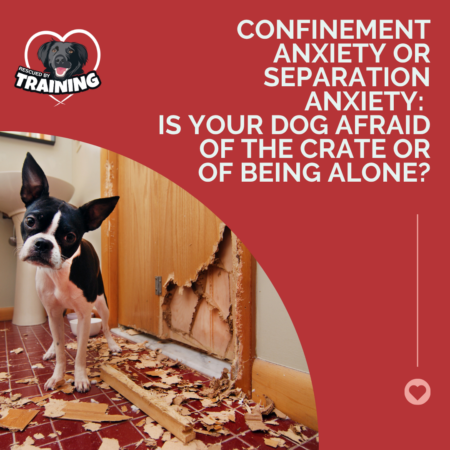

One of the most common things I hear from new clients is some version of this: “My dog has separation anxiety. He freaks out every time I put him in his crate.”
I understand why those two things feel connected. In many homes, confinement and being left alone happen at the same time. You crate the dog, you leave the house and then your dog panics so from where you’re standing, it looks like one problem.
But really, it might be two. And if we’re treating the wrong one, or treating both as if they’re the same, can slow your progress significantly and in some cases make things worse. This is why working with a qualified behavior consultant and separation anxiety specialist, like me, is so important.
Why these two things get so easily confused
Here’s the setup most people are working with: the dog goes into the crate, the owner leaves, the dog loses it. Barking, whining, scratching, destructive behavior, potty accidents. The owner naturally assumes separation anxiety because the dog is distressed when left alone.
But let’s consider what’s actually happening in that scenario. The dog is confined and alone. Both things are true simultaneously, and the dog’s distress could be rooted in either one, or both and you can’t know which is driving the behavior just by watching what happens when you leave. You need to separate the variables, which I’ll get to in a moment.
“But my dog uses the crate when I’m home”
This is one of the most common reasons people rule out confinement anxiety too quickly, and I completely understand why. If your dog voluntarily naps in the crate, or settles in it without complaint when you’re puttering around the house, it feels like evidence that the crate itself isn’t the problem.
But here’s the important distinction: a dog who tolerates or even chooses the crate when their person is present and accessible is not necessarily a dog who is fine being confined when alone. Those are two very different emotional experiences for the dog and doesn’t necessarily mean the dog is comfortable in the crate when you’re not around.
When you’re home, the crate is just a cozy spot. You’re nearby. The dog can hear you, smell you, and potentially see you. There’s no threat of abandonment attached to that space. But the moment confinement and your absence happen together, that picture changes and the emotional situation changes.
For dogs with confinement anxiety specifically, it’s often the restriction itself that becomes intolerable when they’re already stressed. A dog who is anxious about being alone and then also cannot move freely, cannot pace, cannot seek an exit, is a dog whose distress gets compounded. The crate didn’t cause the anxiety, but it can intensify it significantly.
So if your dog seems perfectly happy in the crate while you’re home, that’s not a guarantee the crate is neutral when you leave. It just means the crate alone isn’t the trigger. The combination of confinement plus your absence might be.
Let’s pause and talk terminology, because it matters
The term “separation anxiety” gets used a lot as a catch-all for any dog who struggles being left alone and that’s why I use it on my site and in my files. But it’s worth knowing that the field has moved toward more precise language.
The broader umbrella term now widely used is separation-related behavior (SRB) or separation-related problems (SRP). This covers any distressed behavior a dog shows in response to being separated from a person or people they’re attached to. It’s the umbrella.
True clinical separation anxiety is a more specific clinical veterinary diagnosis within that umbrella. It refers to a dog who panics specifically when separated from their primary attachment figure, usually one particular person. While most dogs with separation related behaviors are completely fine with other people present (I joke they just need a warm body – they don’t care who is it, which is why daycare or a dog sitter works great for management), true separation anxiety dogs panic if their ONE person isn’t present, even if other people are around. The distress is person-specific, not just about being alone in general. This is a much more complex situation and is, luckily, much less rare in presentation (reportedly less than 1% of cases).
Confinement anxiety is a different animal entirely. A dog with confinement anxiety is distressed by being physically confined or restricted, regardless of whether anyone is home. The trigger is the crate, the baby gate, the closed door. Not the absence of the person.
How to start telling them apart
The way to begin separating these out is to test the variables independently.
First, try leaving your dog alone without confining them, if it’s safe to do so. Set up a camera and step outside for a few minutes. Does your dog settle? Does the distress look similar to what happens when they’re crated, or does it look different or milder?
Next, try confining your dog while you’re still home. Crate them or put them behind a baby gate and go about your normal activities in another room. Watch what happens. Does your dog panic even though you haven’t left? That’s a meaningful data point.
If your dog is distressed in the crate regardless of whether you’re home, confinement anxiety is likely part of the picture. If your dog is only distressed when you’re absent, and is fine confined when you’re present, the confinement itself probably isn’t the core issue.
Many dogs have some degree of both, which is why this isn’t always a clean either/or answer. But knowing which component is dominant changes how you approach training.
Why this distinction matters for treatment
If your dog has separation related behaviors and you respond by tightening confinement, trying a different crate, or adding crate covers and calming sprays, you’re not addressing the actual problem. The anxiety is about being separated from you, not about the physical space. Confining more doesn’t help and can actually make things worse. I’ve seen dogs with broken teeth, bloody paws, and broken nails from trying to escape confinement that was never the right solution for what they were actually experiencing.
On the other hand, if your dog has confinement anxiety and you spend months on a protocol specifically designed for separation anxiety, you may see limited progress because you’re treating the wrong thing.
And if your dog has both, you need a plan that addresses both, in the right order and with the right approach for each.
The bottom line
If your dog is struggling when left alone, the first step isn’t assuming you know what’s driving it. That distinction changes everything about how we help them.
If you’re not sure where to start, that’s exactly what an initial consultation is for. I can help you sort through what’s going on and build a training plan that actually targets the right problem. You can book a session here or check out my Separation Anxiety Foundations course if you’re looking to get started on your own with some professional guidance.
And if you are not already on my weekly newsletter list, come join me. Free tips, client wins, and real talk about living with and training hard dogs.
If you would like to support my efforts and make a contribution to allow me to continue to create free resources like my blog and all of my other free resources, you can Buy Me A Coffee!


(This post contains affiliate links. If you click the link, I earn a small commission, at no extra cost to you.)
Happy training!