
If you are struggling with your dog’s behavior, I want you to hear this first.
You are not failing.
You are not behind.
And you absolutely deserve qualified help.
But I want you to also know that the quality of information you get and who you hire matters. A lot.
Professional licensure is not required to call yourself a dog trainer nor is there any industry specific government regulation. Anyone can wake up tomorrow, print business cards, make an Instagram account, and call themselves a trainer or “behaviorist.” There is no governing board. No minimum education requirement. No licensing standard in most of the United States. That means the burden falls on you to vet the person you are trusting with your dog. And that is a heavy lift when you are already stressed.
When you are dealing with fear, anxiety, reactivity, or aggression, this is not a sit and stay problem. This is behavior rooted in emotion. And fear is not disobedience.
Qualified behavior consultants understand:
• Learning theory
• Applied behavior analysis
• Body language and stress signals
• Medication considerations and collaboration with veterinarians
• Humane, evidence based intervention
• Risk assessment and safety planning
This work requires education. It requires continuing education. (As of this writing I have almost 300 CEUs.) It requires mentorship, case review, and ethical standards. It is not something you master from watching videos or shear “experience” just owning dogs. It can be hard for consumers to decode and understand all the letters and professional certificates out there. My post here includes details about all of that to help.
That post explains the difference between trainers, behavior consultants, veterinary behaviorists, and what credentials actually mean. Titles matter. Education matters. Oversight matters. And sometimes you may need both a behavior consultant AND a veterinary behaviorist.
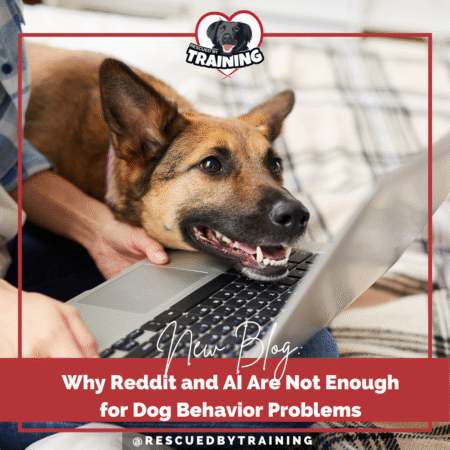
Why Not Reddit or AI?
The internet is full of opinions. Reddit threads. Facebook groups. Comment sections. TikTok experts. And yes, AI.
But here is the problem. Advice without context is dangerous. No one on Reddit has assessed your dog. They have not taken a behavioral history. They have not observed body language. They do not know your dog’s thresholds, environment, medical history, or bite risk. They are giving you generic answers to a highly individual problem.
And AI cannot evaluate your dog. It cannot observe subtle stress signals. It can’t connect behavior to possible pain or other underlying physical issues. It cannot intervene in real time when things escalate. It cannot collaborate with your veterinarian if medication or other treatments are needed. It is just going to recycle things it has learned from you and feed you want you want to hear.
Behavior work is nuanced. Timing matters. Setup matters. Data tracking matters. Subtle shifts matter.
One piece of poorly timed advice can worsen fear. One suggestion to push your dog too far can set training back weeks or months. General information is not the same as behavior intervention or modification. And that free advice you’re getting can become a very expensive problem. If you think professional help is costly, read my post here.
And if you want to read about what red flags to watch for, read that here.
When you hire a professional, you’re not just paying for the time in those sessions. You are paying for years of education, mentorship, insurance, continuing education, website and marketing costs, case consultation, and the emotional labor of supporting families through hard behavior cases. You are paying for someone who knows what to do and what not to do, and when to refer out.
When people tell me they tried a board and train or “boot camp”, or followed advice from an online forum, and now their dog’s behavior issue is worse, or the dog stopped growling or giving warning signs and now “just bites out of nowhere”, it breaks my heart. Behavior problems do not get better because someone applied more control or scared the dog into learned helplessness. Behavior improves when we reduce fear, change associations and create safety. Behavior suppression is not behavior modification.
Changing underlying emotion, teaching safety, management, body language skills and reducing fear takes skill. It also takes humility. Ethical professionals refer out when needed. We collaborate with other professionals and veterinarians. We stay in our lane. If someone is trying to sell you certainty, guarantees, quick fixes, or dominance based narratives, run away. Your dog’s emotional wellbeing is not something to experiment on.
And if you are feeling overwhelmed right now, I understand. It’s a lot to process. But know this, getting qualified help is not a failure. It is advocacy and love for your dog.
The right professional can change everything. Read my testimonials to see the difference a qualified trainer can make in your life.
If you are new to online remote training, I recommend you read my post here on why this type of training is preferred for fearful or aggressive dogs. I know it can feel weird to not have the trainer in your home but it’s actually easier on your dog. And it helps you learn the skills you need to in order to live with your dog when we’re not together.
If you’re ready to take the first step towards helping your dog, you can schedule your session here!
If you would like to support my efforts and make a contribution to allow me to continue to create free resources like my blog and all of my other free resources, you can Buy Me A Coffee!


Proud Partner Of The Farmer’ Dog. Get a special discount on your first box.

(This post contains affiliate links. If you click the link, I earn a small commission, at no extra cost to you.)