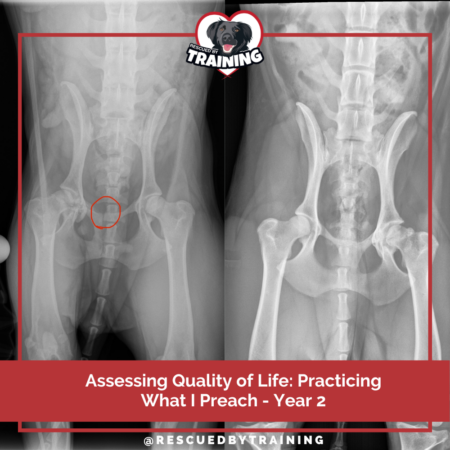

A little over a year ago, we adopted a new dog, Gertie. Full name: Gertrude Wigglebottom, because if you’ve seen some of my videos of her…well, it’s obvious.
If you’ve been here a while, you might remember that just four days after making her adoption official, we had a bombshell orthopedic consult. We had fostered her for several weeks and noticed that when she ran, she would sometimes limp, skip or completely avoid bearing weight. I was preparing myself to hear CCL tear, maybe hip dysplasia.
But I was not prepared for five separate diagnoses that the surgeon would talk about for over 90 minutes:
- Fractured hip
- Fractured pelvis
- Hip dysplasia
- Bilateral CCL disease
- Luxating patella on one side
I think I zoned out during that appointment for bit. Gertie was a stray, so the hip fracture was not shocking on its own. We guessed she was likely clipped by a car at some point leaving her left femoral head out of place and rubbing where it absolutely should not have been rubbing. But hearing everything, seeing the x-rays, and then hearing the potential $20,000 price tag if she needed all the surgeries discussed… I was completely numb staring at the clinic floor. I was thinking about her pain, her quality of life, whether we had just gotten in way over our heads adopting a young dog whose body was already failing her and what all of our futures might look like.
When I got home, I pulled myself together and I did what I advise my clients to do. I treated myself like a client and I completed a quality of life assessment for Gertie.
I wrote about that process at the time here, and that assessment became our baseline. Now I can compare where she started in 2025 to where she is now and look for trends, improvements, or red flags. For her I decided to use the Lap of Love Quality of Life Scale and the BEAP Pain Scale. I have links to both on my Grief Resources page. (I use different scales for different clients, based on what I think we need to track.)
Because the surgeon said nothing was urgent, and because we thought she had heartworms at the time (she did not, which is your reminder to test twice or more), we chose a multimodal management approach instead of immediate surgery.
That included:
• Daily NSAIDs to reduce inflammation and manage her pain
• Fish oil and other joint supplements
• Adequan injections, which I administer at home
• Physical therapy exercises, done at home with equipment I already had
• Laser therapy, also done at home
• Regular leash walks encouraging balanced weight bearing
When she arrived to us, she was not weight bearing on that left leg due to the hip fracture and her left hamstring measured just 22 cm. You could see just how profoundly atrophied it was from both the x-rays and just by looking at her.
Today, both legs measure 40 cm. (Check out the muscle mass gain in the image below of her left hamstring. I’m super proud of this!) Let that sink in! 22 to 40! Woohoo!
And just like I recommend to clients, I recently redid her quality of life assessment a few days before her recent follow-up appointment for repeat x-rays. I have watched her blossom this past year. But seeing the data in black and white? That is the validation that I needed. I knew she no longer needs daily pain medication but seeing the improvement in the year over year just hits differently seeing it on paper.
Her quality of life score improved, especially in mobility. And just as meaningful to me, my worry score improved too. That human component is one of the reasons I love the Lap of Love scale. It acknowledges that we matter in this equation. Caregiver burden is real. Emotional weight is real.
And then we had our vet appointment, which miraculously showed both her pelvic fracture and hip fracture healed! This was the best possible news but also further validated that my QoL assessment was accurate, because I had done it before I knew her fractures had healed.
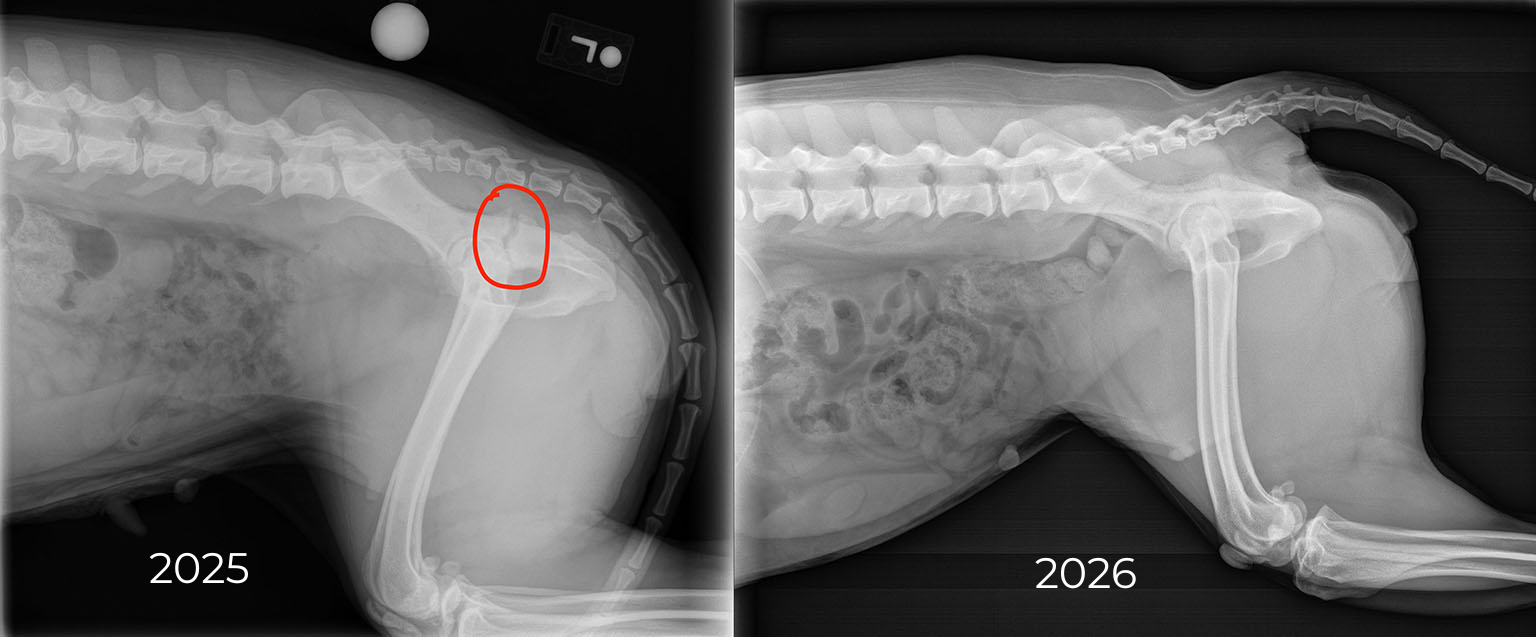
red circle shows fracture on left from 2025, right side shows no fracture!
In my role as an end-of-life doula, I work with animals when there are very few decisions left to make. Much of the path is already defined by disease progression. With Gertie, my grief and shock last year were tied to something different. We had just lost Boo ten months earlier. My mind started to spiral about us having to euthanize her. And I couldn’t quite wrap my brain around it.
She is young. She is vibrant. She is sooooo happy. And yet we were suddenly having conversations about surgery risks, multiple procedures, long recoveries, and long-term comfort and mobility. My husband and I talked about all of it. What are we willing to put her through? What outcomes matter most? What does success look like? What is our line in sand for her?
I am deeply passionate about quality of life planning, for both humans and animals, because planning reduces stress later. When we think ahead, we are calmer decision makers. As an active foster family and rescue advocate, I see what happens when these conversations never occur. Our shelter recently took in a
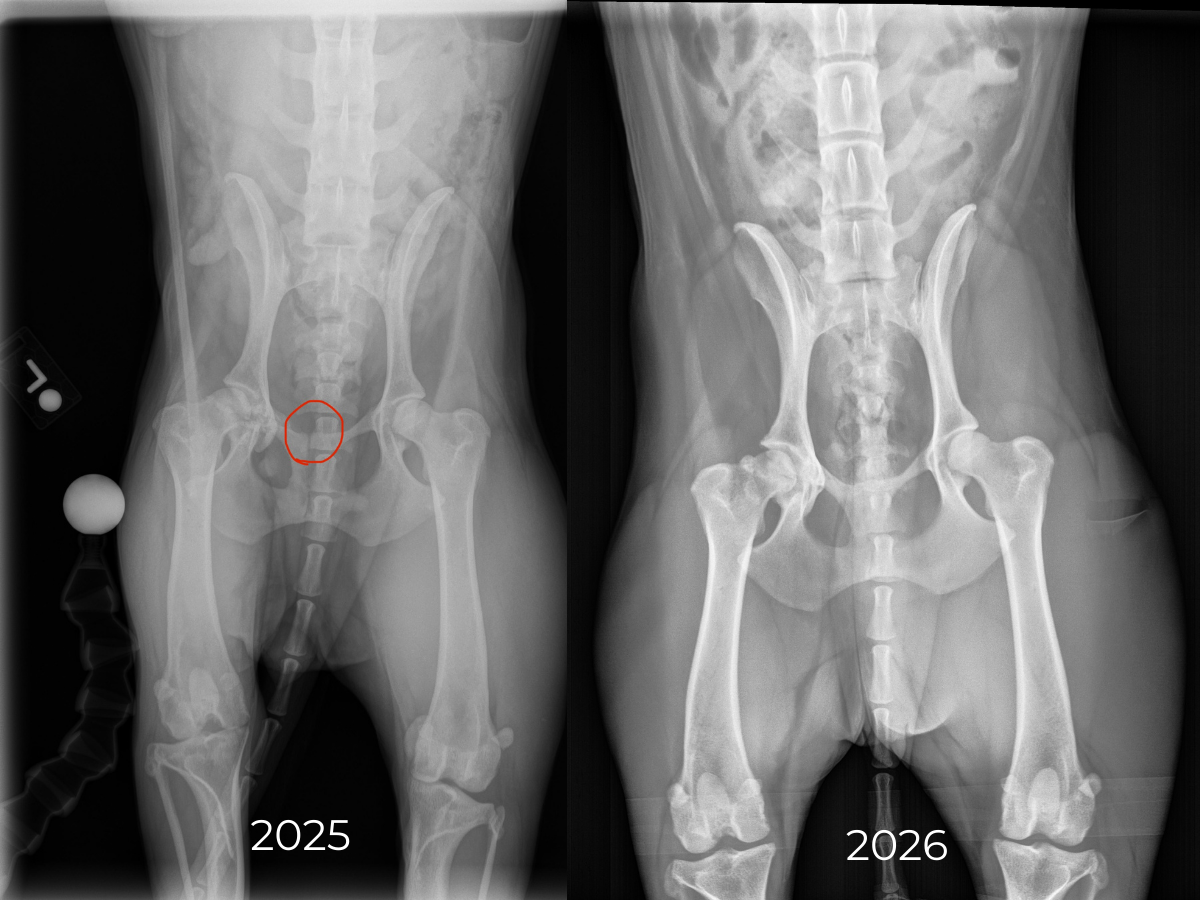
red circle shows fracture on left from 2025, right side shows no fracture!
13-year-old dog, severely arthritic, surrendered because his guardian was entering hospice care and had no one to take him. These are painful realities. But avoiding the conversation does not make the reality kinder.
That is why I wrote What If Your Animal Outlives You? Proactive planning is an act of love.
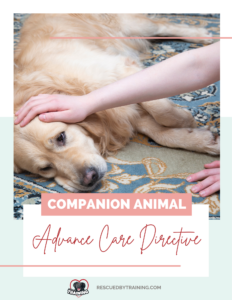
My Companion Animal Advance Care Directive exists to help you start these conversations, before you are in the emotional trenches. Making quality of life and end-of-life decisions for a companion animal is one of the greatest responsibilities we carry as guardians. Our animals cannot tell us which treatments they would choose. But we know them. We know what makes them happy. We know what frightens them. We know what makes them feel safe.
When we avoid conversations about what we are or are not willing to do medically, we often end up making decisions in the heat of crisis. Those decisions may be driven by fear, by guilt, by financial strain, or by the sheer shock of the moment. And that is a heavy place to decide from.
But, when we think ahead, when we define our values and thresholds in advance, we are better prepared. Even with a young, bouncy puppy, it matters. Especially then. Because when they are old or sick or fragile, we are not thinking clearly. We are grieving in real time.
I always tell clients to prioritize quality over quantity. Many veterinarians say it is better to say goodbye a week early than an hour too late. We cannot prevent death. But we can prevent suffering.
By planning ahead, we can honor our beloved animal by taking the time to think about different options and avoid making last-minute, emotionally charged decisions.
 I strongly encourage completing a quality of life assessment at least once a year throughout your animal’s life. Choose a date you will remember. A birthday. A gotcha day. Consistency matters because it creates meaningful comparison data year over year. For Gertie, it’s around her Gotcha Day, because it’s easy to remember and that’s when this ortho consult originally happened.
Quality of life assessments and Advance Care Directives are living documents. They evolve as your animal ages and as your circumstances change. Updating them is not a failure. It is responsible guardianship.
Companion animals are family to me. I assume they are to you too. And just as I would ensure a plan exists for a human child, I believe it is my responsibility to have a plan in place for them.
You can download the Companion Animal Advance Care Directive and begin those conversations today. If you would like guidance, I am here through my doula services.
If you would like to support my efforts and make a contribution to allow me to continue to create free resources like my blog and all of my other free resources, you can Buy Me A Coffee!

Happy training!

Proud Partner Of The Farmer’ Dog. Get a special discount on your first box.

(This post contains affiliate links. If you click the link, I earn a small commission, at no extra cost to you.)