
Barking is completely normal dog behavior.
Barking is completely normal dog behavior.
Barking is completely normal dog behavior.
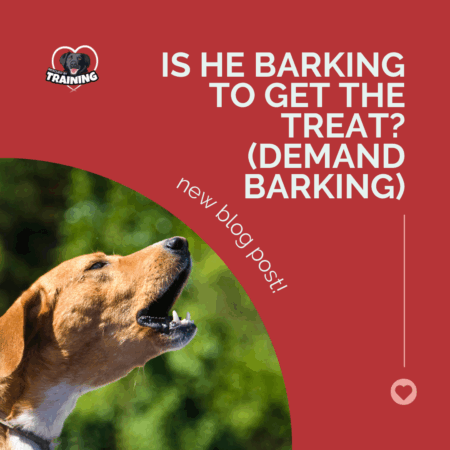
While it may be annoying, barking is your dog’s way of communicating something. There are many reasons why a dog might bark but this post is going to dive into demand barking.
Demand barking happens when your dog wants something. This might be your attention, food, toys, to go out, to get other dogs to play or other similar situations where your dog is trying to communicate a need or want. Dogs who demand bark are not typically stressed, anxious or upset – they’re just trying to tell you they want something. Dogs who have FOMO (fear of missing out) may demand bark when they think they’re missing the party if they’re behind a gate, closed door or locked outside. For these dogs, this can tip into anxious barking in some cases (most commonly separation anxiety dogs).
What can demand barking look like?
- Your dog barks at you around dinnertime. (Hey, it’s almost dinnertime!)
- Your dog barks at your as you’re prepping his meal. (Hurry up! I want my dinner!)
- Your dog barks at you after bringing a toy. (Let’s play!)
- Your dog barks at you when you’re sitting at your computer or working. (Pay attention to me instead of that screen!)
- Your dog barks at the door or barks at you and goes to the door. (I need to go out!)
- Your dog barks at other dogs and had loose body language. (Let’s play!)
- Your dog barks when separated. (I would like to be with you! I’m think I’m missing out on something fun!) Note: this could also be confinement or separation anxiety, so best to work with a qualified trainer to know the difference.
Pro tip: Yelling at your dog when he’s barking won’t make him bark less. This Harry Bliss comic is perfect. And, yelling at your dog could actually cause long-term behavior issues like fear.
It is also important to know that barking can be self-reinforcing, meaning the dog gets enjoyment (or reinforcement) from the act of barking, so barking doesn’t normally extinguish or go away on its own. This is why simply ignoring the barking won’t typically reduce it. Managing your dog’s environment, setting the dog up for success, providing mental and physical enrichment and proper positive reinforcement training to teach the dog what to do instead is key to helping your dog bark less. Download my free Dog Trainer’s Toolkit to see some of my top choices for management.
One question I get from my fearful dog clients when we’re using a lot of food in cases like stranger danger is “won’t he just bark to get them food then?” In these cases, where I am having clients feed their dog around scary strangers even if they’re barking feels counterintuitive, but fearful dogs are barking because they’re afraid of people and the only way to turn that negative into a positive is using food, regardless of their barking. In some cases, when the fear has improved, some dogs may still bark to demand food, but that isn’t something I see often, and honestly, that’s a much better problem to have than a dog who is barking because they’re fearful.
For dogs who are upset when they’re barking, we have to help them feel better about the thing they’re afraid of, whether it’s being alone, strangers, dogs, noises or anything else. Behavior modification like this requires a lot of nitty gritty detail work to help the dog feel better so you should schedule a separation anxiety assessment or a fear and aggression consult if your dog is having barking issues because he’s upset. And remember, we never punish a dog for communicating – behavior suppression isn’t behavior modification.
If you need help with this or anything else, grab your one on one session with me here! And, be sure to sign up for my free weekly newsletter so you don’t miss out on free tips, videos, personal stories, client successes and more!
If you would like to support my efforts and make a contribution to allow me to continue to create free resources like my blog and all of my other free resources, you can Buy Me A Coffee!

Happy training!