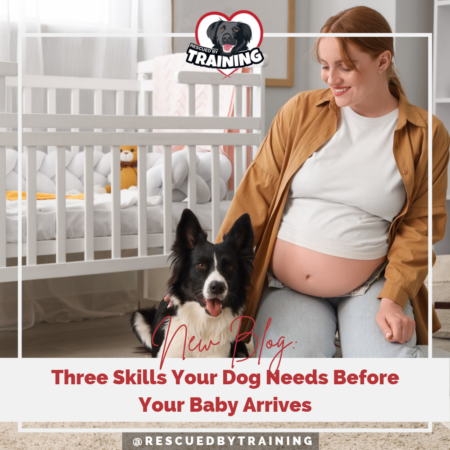

As a licensed Family Paws Parent Educator and multi-credentialed, certified behavior consultant whose speciality is fear and aggression, I work with a lot of families with dogs and kids. If you’re expecting or trying to adopt or get pregnant, you may be wondering what you should be working on and when you should start preparing for dog and baby. The answer is now! The more lead time and training time we have to help train behaviors, identify trouble areas and make environmental adjustments, the better it will be for everyone.
What should be working on? Well, that will depend on how much time we have. Behavior change takes time. With that in mind, here are three skills your dog must have to safely live with your baby. These skills must be worked on before your baby arrives. This is not a complete list by any means. There is a lot more involved in preparing a dog for a new baby, but these three give you a strong starting point. If you’re looking for more guidance, check out my Bringing Home Baby course here. You may also be interested in my Bringing Home Baby blog series here.
Three Skills Your Dog Needs Before Your Baby Arrives:
- Separation: your dog needs to be able to be comfortable being physically separated from you and your baby, whether that is a closed door, baby gate, crate or other physical separation.
- Leave it and Drop it: your dog needs to be able to be asked to ignore items that aren’t theirs or that may be dangerous or to drop an item in their mouth they’ve picked up (like a baby sock or teething ring)
- Go to bed/place/mat/crate: your dog needs to reliably respond to moving away from you and baby specific distractions (like you sitting on the floor during tummy time) and stay where you’ve asked them to go
- Create kid-free, dog-safe spaces for your dog.
- Take my free dog body language course to learn dog signs of stress, anxiety and more.
- Leave a child alone with a dog, even for a second to run to the door or go to the bathroom or receive a delivery.
- Expect a dog to tolerate a child kissing, hugging, crawling on, laying on, pulling or moving towards the dog.
- Think your dog will never hurt your child.
- Think your child will not hurt your dog, intentionally or not.
As a Family Paws Parent Educator, I help families through every stage from planning to the day you bring baby home through toddlerhood. And as a certified behavior consultant, I am also here to help if your dog starts growling, avoiding, or showing other signs of discomfort once the baby is actually home.
If you are ready for a structured, self-paced course, my Bringing Home Baby course walks you through exactly what to do and when to do it, so you are not guessing your way through this important time in life. Check it out here to get started while you still have the time to prepare properly.
If you’re ready to take the first step towards helping your dog, you can schedule your session here!
If you would like to support my efforts and make a contribution to allow me to continue to create free resources like my blog and all of my other free resources, you can Buy Me A Coffee!

Thanks for being here!

(This post contains affiliate links. If you click the link, I earn a small commission, at no extra cost to you.)