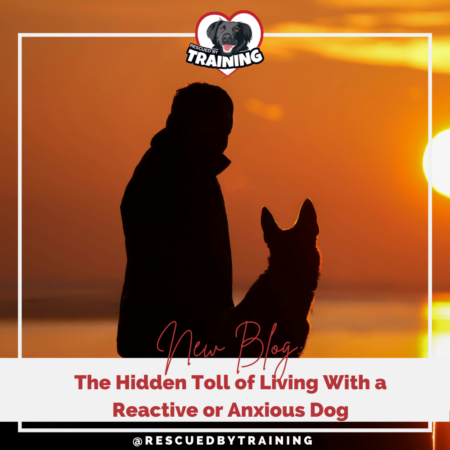

If you share your life with a hard dog, whether they’re reactive, fearful, anxious, aging, or struggling to with strangers or your child, there’s a version of your life you’ve quietly let go of. Maybe you stopped having people over because your dog can’t handle it, or they have to stay put away or behind a gate for everyone’s safety. Maybe you haven’t taken a vacation in years because finding someone who can manage your dog’s needs feels impossible, or because the guilt of leaving them is too heavy to bear. (I understand that one…my husband and I didn’t vacation together for over a decade because our first dog, Bandit, was aggressive and couldn’t be left with anyone but one of us.) Or, maybe you’ve changed your walking route, your schedule, your social plans, your career, your housing choices, all around a dog whose needs are invisible to most of the people in your life.
This is the hidden toll of living with a reactive or anxious dog. And I don’t think we talk about it openly enough and it just sort of stays lurking in the shadows.
You’ve rearranged your whole life, and most people have no idea
When someone lives with a dog with separation anxiety, the limitations are immediate and life-altering. You must suspend absences so your dog doesn’t have a panic attack, so that means you can’t leave for more than a few seconds or minutes without causing your dog distress. As a result, you have to turn down dinner invitations, decline work trips (or make arrangements for your dog) and can’t make spur of the moment plans to go out. You become, as many of my clients describe it, a prisoner in your own home.
But reactivity does this too, just differently. Maybe it means you stop going to the dog park because it’s not safe or it’s too stressful. Or you time your walks to avoid peak hours or avoid people and dogs entirely. (I have a client now who walks his dog at 4am!) Walks are stressful from being on alert all the time, crossing the street, ducking behind barriers or into driveways or parking lots or turn around mid-block. You scan every environment before your dog enters it and you become a constant threat assessor, always two steps ahead, always watching for the thing that’s going to send your dog over the edge. Some clients try to make it “fun” and act like they’re in a real-life video game, but I know it wears on them, because I’ve lived like this.
And, you do all of this without anyone around you really noticing, because maybe to them, your dog looks “fine.” Maybe your dog looks “fine” at home or in the backyard. To friends and family and those not living with it, nothing seems wrong. But if they look “fine” it’s because you know your dog’s struggles and triggers and have worked really hard to prevent them from being set off.
The mental load is relentless
Living with a hard dog is mentally exhausting in a way that’s hard to explain to someone who hasn’t done it. It’s not just the training sessions or the management protocols, though those take real time and energy, but it’s the constant, low-grade vigilance that never fully turns off. You’re never fully off-duty and can never let your guard down or fully relax.
Will today’s walk be okay? Did that visitor stay too long and stress the dog out? Is the dog trigger stacked right now? Should I cancel these plans because something stressful happened earlier? Is this a regression or just a bad day?
That mental load accumulates. And because it runs in the background all the time, it can be hard to even recognize how tired you are until you’re really, truly depleted and burning out. This is where caregiver burnout starts to kick in.
The social cost is real
Reactive and anxious dogs can quietly reshape your social life in ways you might not even realize at first. You stop inviting people over because it’s too complicated. You can’t go out to dinner with your partner. You stop accepting invitations because you need to get home. All of this causes a slow drift from friends who don’t understand why you can’t just “leave the dog for a few hours” and relationships strain under the weight of logistics that other people don’t have to manage. And then friends stop inviting you, because you are always declining.
Partners sometimes disagree about how much to accommodate the dog, which creates its own friction. Family members offer well-meaning but unhelpful advice. People suggest you rehome the dog, or try a different trainer, or “just be firm,” and you spend emotional energy either explaining or smiling and nodding when you don’t have the bandwidth to do either. The social isolation that can come with living with a hard dog is something I hear about regularly from clients. It’s not dramatic, it’s a real narrowing of your world and that can be hard, and painful.
You grieve the dog you thought you were getting
This one is something a lot of people don’t recognize. People who live with reactive or anxious dogs are often carrying a quiet grief for the experience they imagined having. You pictured hikes, off-leash beaches, trips to the coffee shop and dog-friendly outdoor dining. You imagined a dog who would love your friends, travel with you and go everywhere with you that they’re allowed but instead you have a dog who needs a very specific kind of care and a very specific kind of life. That dog is still loved, often deeply, but the reality is not what you imagined and it is okay to grieve that loss.
Feeling grief about this doesn’t mean you love your dog less or that you regret your decision. Admittedly, in some cases, rehoming is the best option for the dog and the family.
Burnout is a real risk
I wrote about caregiver burnout a few years ago and the core of it still holds: when you pour everything into caring for a dog with significant needs, without support, without breaks, without realistic expectations, you will eventually hit a wall. That’s not a character flaw or anything wrong with you – it’s just how humans work.
The risk goes up when you’re doing all of this alone. When no one in your household is sharing the load or if you’re uncoupled or if your trainer isn’t keeping expectations realistic, burnout will hit faster. And when you’re not building any relief into your week or you have no relief or help and feel like you can never step back, even briefly, without failing your dog, burnout will be knocking on your door before you know it.
If you’ve lost motivation to train, if you’re finding yourself resentful, if the joy you once felt about your dog has been replaced by something heavier, those aren’t signs that you’re a bad owner. They’re signs that you’re depleted and need support.
What actually helps
A few things I come back to consistently with clients who are in this place:
- Get honest about the mental load. Name it, at least to yourself. Saying “this is hard and it’s affecting me” is not a betrayal of your dog but is the first step toward being sustainable for them. The analogy I say over and over is the airplane one – you have to put on your own oxygen mask first before helping others. If you can’t take care of yourself, then you won’t be able to help your dog.
- Build in real breaks. Not just training breaks, but genuine time off from the vigilance. Working to find a dog sitter who understands your dog’s needs, even once or twice a month, can make a meaningful difference. Daycare, if your dog can tolerate it, is another option. Letting yourself have a few hours where you’re not in caretaking mode matters. It might take work and training to get there, but it’s worth it if long-term you can get yourself some relief.
- Lower the bar on hard days. Not every week will have training sessions. Not every walk needs to be a success. Progress in behavior modification is not linear, and your job is not to hold everything together perfectly. Some days managing without a setback is enough.
- Find your people. The people who get it, including a qualified trainer who normalizes what you’re going through, or even just one friend who doesn’t make you feel judged for your dog’s behavior. Isolation makes everything harder.
- Seek professional support if you need it. For your dog, yes, but also for yourself. If your dog’s behavior is significantly affecting your mental health and quality of life, talking to someone about that is not an overreaction.
You deserve support too
Your dog’s needs are real and they deserve to be met. And so do yours. Those two things aren’t in conflict.
If you’re struggling with a reactive or anxious dog and you’re not sure where to start, I’d love to help. You can book a session here. You don’t have to do this alone. You’ve been showing up for your dog. Let someone show up for you.
If you would like to support my efforts and make a contribution to allow me to continue to create free resources like my blog and all of my other free resources, you can Buy Me A Coffee!

Thanks for being here!

Proud Partner Of The Farmer’ Dog. Get a special discount on your first box.

(This post contains affiliate links. If you click the link, I earn a small commission, at no extra cost to you.)