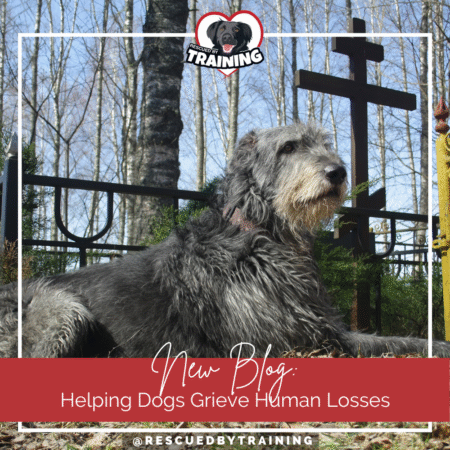

Over the holidays I watched a new movie, whose premise was a couple that had broken up and were sharing custody of their dog. But when the dog was only with one of them, he was “depressed” as the vet diagnosed him. I’ll spare you the whole rom-com plot – I’m sure you can figure out where it went but it got me thinking about dogs and grief when they lose a human, whether from a breakup, divorce, job change or death. In my doula and pet loss grief work I sometimes get called on to help animals navigate or prepare for the loss of a human in the family and I’m asked
“Do dogs grieve the loss of a human?”
While I can’t answer with absolute certainty, as there’s not a huge body of research on dogs and grief, we do know dogs have evolved alongside humans for thousands of years, creating to an intense interspecies bond. And we know from separation anxiety research that dogs have strong attachments to their human caregivers, and when dogs are separated from their owners, many dogs exhibit distress behaviors. (Schwartz, 2003).
Some people describe their animals had behavior changes, were not interested in food or laid on the deceased person’s clothing or bed, after the passing of a close human companion (King, 2013). When any family member, human or animal, dies or becomes ill, everyone in the family is aware of it and in fact, dogs’ incredible sense of smell likely makes them aware of physical changes before we are.
Dogs are social animals that rely on relationships and social groups for security, so when a family member is lost, that social structure is disrupted and can cause anxiety. Dogs are known to experience distress when separated from an individual to whom they are strongly attached, whether human or animal. When a family member dies or moves out, that permanent separation can lead to separation-related behaviors similar to diagnosed separation anxiety.
There is not a huge body of research on this topic, and we must be careful not to over-anthropomorphize but dogs are deeply aware of our routines and emotions. Just because they may not have the same emotional response that humans do, doesn’t necessarily mean they’re not affected. What we label as grief in dogs may be a response to the changes in the household that follow a death or break-up. And likely, the remaining humans are upset and emotional, routines change, and those changes can be upsetting for the dog and may look like grief to us.
We do know that when a housemate dog dies, behavioral changes in the remaining housemate has been documented. There is a paper from 2022 on the topic that has some key takeaways to support behavioral changes in dogs after the loss of another dog in the home. The authors were careful to say we cannot definitively label these changes as grief, but they did document behavioral shifts with 86% of surviving dogs showing negative behavior changes after the death of a housemate dog.
- Key behavioral changes noted were:
-
- Attention seeking behaviors increased (67%)
- Playing less (57%)
- Overall reduced activity (46%)
- Increased sleeping (35%)
- Increased fearfulness (35%)
- Decreased appetite (32%)
- Increased vocalization (30%)
So, do dogs grieve when there is a death or loss of a human? Maybe but not necessarily in the same way we think of grief. Even if it’s not the same, we still need to help them navigate that loss. If it is a death, I suggest allowing the animal to be present with the declining person, and if possible, to see the body after the passing. I think animals understand death, but not disappearance.
What can you do to help your grieving dog?
- Maintain a routine. Predictability helps dogs feel safe.
- Provide increased attention, if you dog wants it.
- Increase activities together – walks, especially low-impact, low-stress sniffaris, car rides (if your dog likes cars), special treats, easy or fun training like rehearsing behaviors your dog already knows or enrolling in an online fun tricks class that is low pressure
- Increase mental enrichment, especially activities that involve sniffing, searching and licking, as these can help increase the release of happy endorphins
- Arrange playdates or walks with other dogs to provide social interaction
- Talk to your vet about if medication would be appropriate, even short term to help with the adjustment
If you would like to support my efforts and make a contribution to allow me to continue to create free resources like my blog and all of my other free resources, you can Buy Me A Coffee!

Thanks for being here!

Proud Partner Of The Farmer’ Dog. Get a special discount on your first box.

(This post contains affiliate links. If you click the link, I earn a small commission, at no extra cost to you.)
More reading:
Mariti, C., Papi, F., Mengoli, M., Moretti, G., Martelli, F., & Gazzano, A. (2021). Domestic dogs (Canis familiaris) exhibit individual preferences in showing attachment behaviors toward their owners. Animals, 11(2), 320. https://doi.org/10.3390/ani11020320
Gácsi, M., Maros, K., Kira, S., & Miklósi, Á. (2018). The role of attachment styles in dogs’ responses to the absence of close family members. Applied Animal Behaviour Science, 207, 1-11. https://doi.org/10.1016/j.applanim.2018.06.001
Mason, G. J., & Mendl, M. T. (2017). Anticipatory and post-absence behavior in domestic dogs: A study of separation anxiety. Applied Animal Behaviour Science, 191, 47-54. https://doi.org/10.1016/j.applanim.2017.02.001