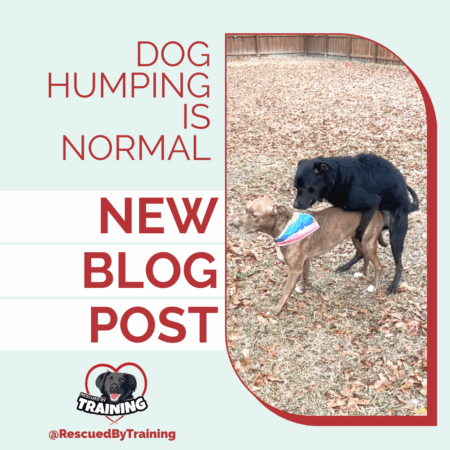

Let’s start by getting this out of the way: dog humping is completely normal behavior.
It’s also one of the behaviors that tends to make people the most uncomfortable and embarrassed. I suspect that has more to do with our own cultural weirdness around sex than anything dogs are actually doing, but that’s a conversation for another day. What’s important to understand is that humping is species-appropriate behavior, not a reflection of bad training or bad ownership.
Many owners come to me wanting to stop what they see as “inappropriate” behavior, often feeling like their dog’s humping somehow reflects poorly on them. This comes up a lot at dog parks, where dogs are excited, overstimulated, and playful. Someone’s dog humps, panic ensues, and the owner rushes over apologizing as if their dog just committed a major social offense. But humping does not automatically mean a dog is being rude.
Humping is what’s known as a fixed action pattern, or FAP. These are behaviors that are hard-wired into a species. They don’t need to be taught and they show up in pretty much all members of that species. Fixed action patterns fall into four general categories: fight, flight, feeding, and reproduction.
As my mentor Jean Donaldson puts it in her book Oh, Behave:
“Reproductive behavior is, evolutionarily speaking, the most important. Any animal that lacks super-duper strong courtship and reproductive FAPs doesn’t pass on their genes.”
Unlike people, dogs aren’t particularly selective about the target of their humping. It can be directed at other dogs, people, cats, or even inanimate objects like pillows, blankets, or couch cushions.
So let’s clear up a few things.
Humping is NOT:
- Dominance
- An attempt to control you
- Alpha behavior
- Something only unfixed dogs do
- Something only male dogs do
- Only targeted at the opposite sex
Humping CAN be:
- Excitement
- Sexual rehearsal or self-stimulation
- A way to burn off pent-up energy
- General arousal like “something is happening!”
- Stress, anxiety, or displacement behavior
- Attention-seeking
- Part of play
In my own house, I’ve seen humping show up in some pretty ordinary moments. My dog Barbo used to hump our other dog, BooBoo, when he was excited or trying to initiate play. It also popped up in the backseat of the car when we pulled into the garage after an outing. In that context, he seemed thrilled to be home and as we gathered our things, he would air hump Boo.
When Boo’s sister Sassy would visit, sometimes she would hump Boo too. Some dogs just seem more humpable than others, I guess.
Most recently with our new dog Gertie, we’ve seen it from fosters we’ve had coming through the house. One of our recent fosters, Maple, was a pretty prolific humper after about 2 days of being with us. Humping seemed to be her go-to behavior to try to initiate play with Gertie. As you’ll see in the video, I let it happen, hoping that Gertie would snark Maple off, because Maple would learn better if that happened. But after a while it became clear Gertie wasn’t going to do that, so I intervened gently.
So what can you do about it?
The first step is to pay attention to when the humping happens. Data matters. Keeping a simple log of context, environment, and triggers can tell you a lot about what’s driving the behavior.
You can also teach an alternate, incompatible behavior such as a recall, a hand touch, or another redirection cue. The key here is not to punish, yell, or try to scare the dog into stopping. That’s especially important if the humping is rooted in anxiety or stress.
Once you start tracking patterns, you can identify the underlying reason for the behavior and address that instead of just trying to shut the behavior down. Ideally, this process also helps you reframe humping as normal dog behavior rather than something shameful or embarrassing.
Personally, as I said, I often just let it happen.
I’ve also had creative clients who chose to give their dog a designated “humping pillow” and redirect them to that object if they preferred their dog not hump their decorative throw pillows or human legs.
If in your data tracking you notice humping popping out as a displacement behavior or in the context of anxiety, then that needs to be addressed to help the dog be less anxious. As with everything, we don’t just focus on the outward symptom, we need to dig deeper and look to treat the root cause of the issue. Remember, behavior suppression isn’t behavior modification.
If you need help, be sure to grab your one on one session with me here!
And, be sure to sign up for my free weekly newsletter so you don’t miss out on free tips, videos, personal stories, client successes and more!
If you would like to support my efforts and make a contribution to allow me to continue to create free resources like my blog and all of my other free resources, you can Buy Me A Coffee!

Happy training!