
When your dog is suffering from separation anxiety, it is completely normal to want to do everything you can, as quickly as possible, to help give them relief and try to help them. A quick internet search will turn up a wealth of recommendations for seemingly quick fixes like leaving the TV on, dressing up a mannequin in your clothes, using a compression shirt, calming chews, frozen food toys, not letting your dog sleep with you, not greeting your dog when you leave or come home and any other number of things that don’t work for dogs with true separation anxiety. It isn’t uncommon for these things to at best, not be effective and at worst, be downright harmful.
Quick fixes may be quick, but they are rarely a long-term solution.
As I’ve mentioned before, separation anxiety training is a slow and long process. Most of my clients are with me anywhere from 3 months to over a year, depending on the client, the dog, medication and many other factors. And practically all of my clients have come to me after having tried some of these “quick fixes” to no avail.
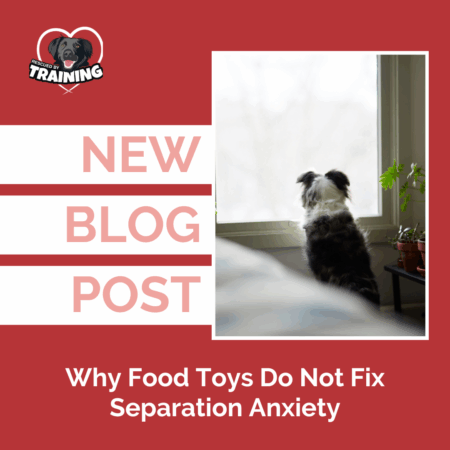
One of the most common recommendations for dogs with separation anxiety is to leave them with a frozen food toy or long-lasting chew so they are “too busy eating to notice you’ve gone.” I’m all in for using food in training, but separation anxiety is one case where food has no place in training. If you have tried this and it did not work, you are not alone and there is nothing wrong with your dog.
For dogs with true separation anxiety, food is not a solution and in many cases it is not usable at all. Some dogs are so distressed by being alone that they refuse food entirely, a phenomenon often called alone-time anorexia. Others may engage with a food toy briefly, only to panic as soon as the food is gone. In these cases, the dog is not comfortable during the absence. They are simply distracted for a short period of time If we think about it, this isn’t too unlike humans. Some people when they’re stressed plow through pints of ice cream, while others get an upset stomach or don’t want to think about food at all.
Distraction is not the same thing as learning.
Food toys do not teach a dog that being alone is safe. They do not change the underlying emotional response to separation. At best, they delay the onset of anxiety, and at worst, they mask it just long enough for guardians to unknowingly push past the dog’s actual tolerance.
There is also no reliable way to predict how long a food toy will last. One day it may occupy a dog for fifteen minutes, another day for twelve. If a guardian plans an absence around the longer estimate and the dog finishes early, those remaining minutes are spent in panic. Even brief exposures to distress can slow progress and undermine the training process.
Effective separation anxiety treatment is not about managing the dog while they panic. It is about preventing panic from occurring at all. This is why we use systematic desensitization. By carefully and gradually teaching the dog that absences are safe and predictable, the dog learns to remain relaxed without the need for distractions or crutches.
There is an additional risk to relying on food during departures. Just as keys, shoes, or a jacket can become predictors of an absence, food toys can also turn into a cue that the guardian is about to leave. For some dogs, this association is so strong that it creates anxiety around food itself. Dogs may begin to refuse food not only during departures, but in other contexts as well, because food has become linked to fear and loss. I had a client a few years back that had been instructed by another trainer to provide a bully stick before departures. Eventually the bully stick became just another cue to the dog that the owner was leaving and the dog got turned off to bully sticks. (This dog eventually graduated my training program and can now comfortably stay at home alone up to 5 hours.)
When a dog is truly comfortable being alone, food is no longer necessary as a management tool. Calm does not need to be bribed or distracted into existence. It is learned through a thoughtful, gradual process that prioritizes the dog’s emotional safety.
Separation anxiety is not solved by keeping a dog busy. It is resolved by teaching them that they are safe, even when you are gone.
If you are struggling with separation anxiety, grab my free guide, 5 Suggestions That Won’t Help Separation Anxiety (And Might Make It Worse)!
I also have my Separation Anxiety Training Foundations (SATF) course, so if you think your dog might have separation anxiety or are looking for some guidance on separation anxiety training, check out my self-paced, affordable course!
Or you can schedule a one-on-one consult for my comprehensive separation anxiety program. Reach out today and schedule your assessment.
Recovery from separation anxiety is possible and I can help Separation anxiety training isn’t a quick fix but it is a simple, scientifically proven process and with proper training, this disorder can be resolved or greatly improved. I can help you and your dog’s quality of life, strengthening your relationship and bringing relief to both of you. Don’t you both deserve that?
If you would like to support my efforts and make a contribution to allow me to continue to create free resources like my blog and all of my other free resources, you can Buy Me A Coffee!

Happy training!